ViewShift has published What Ads Persuade: The 2026 CSR & Reputation Ad Benchmark, a randomized controlled study of 19 CSR and reputation ads from 16 major brands spanning tech, retail, autos, finance, travel, and energy. Each ad was tested in its own randomized controlled trial: one group saw the ad, a randomized control group saw a placebo, and the gap between the two groups on the persuasion measures we tracked is the ad's effect on favorability, trust, consideration, recommendation intent, and reputational resilience.
One of the biggest findings in the report is the one most teams get backwards: brand recall and ad persuasion are almost unrelated.
Brand recall and ad persuasion tell you two different things
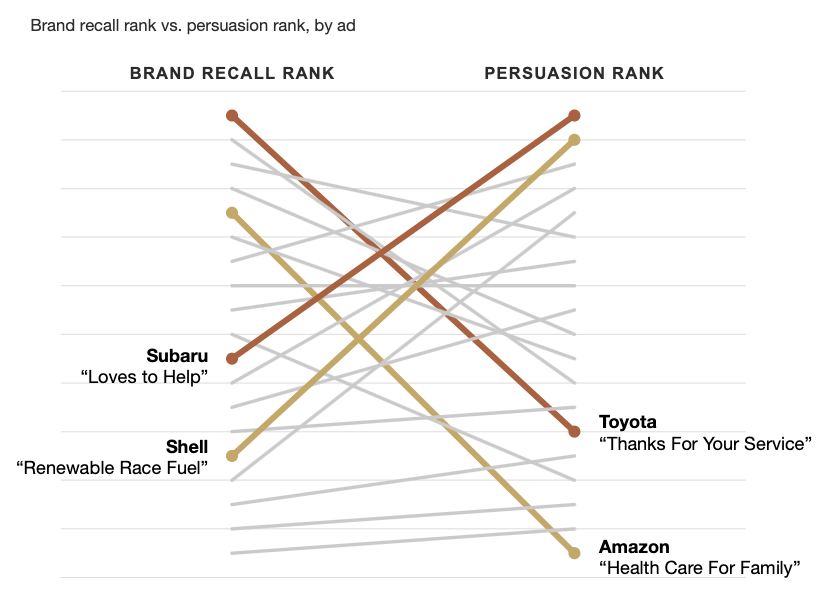
We ranked all 19 ads twice: once by brand recall and once by persuasion. The two rankings barely overlap, with a correlation of 0.06 out of a possible 1.0. Removing the one ad that skews the data most, the relationship is still weak, at 0.18.
Message recall, whether viewers remembered the ad's specific claim rather than just the brand, tracks a little closer to persuasion, but not by much: 0.26 out of 1.0.
Toyota posted the highest brand recall in the study: 94% of viewers could name the brand. It ranked 14th of 19 on persuasion. Amazon recalled at 91%, fifth-highest in the study, and finished last, the only ad to move the composite score backward. At the other end, Subaru and Shell both sat in the bottom half on recall and finished first and second on persuasion.
Why recall and persuasion diverge
Recall and persuasion measure two different things happening in a viewer's mind. Recall is encoding: did the ad get noticed, and did it stick in memory. Persuasion is belief change: did it move trust, favorability, or intent to recommend. There is no reason the two processes should move together, and the data confirms they do not.
Repetition, novelty, and attention-grabbing production drive recall on their own. An ad with a catchy tagline or an unexpected visual can lodge in memory without saying anything credible, new, or relevant to the brand's reputation. That is the gap most ad pre-testing misses: it measures whether an ad got noticed, not whether it changed what people believe.
For corporate reputation advertising, that gap matters more than it does for a typical product ad. A CSR or reputation campaign exists to shift trust and favorability, not to drive brand awareness. An ad that is recalled but does not move persuasion measures has not done its job, whatever it scores on a brand lift tracker. The only way to know whether a CSR ad worked is to test the persuasion outcome directly rather than use recall as a stand-in.
An ad can be memorable and still fail
An ad can be unforgettable and still fail to change a single mind. It can also barely register and still be the one that moves the numbers that matter. If your team uses recall or brand lift trackers as a proxy for whether an ad worked, this is the data that says to stop. Recall tells you whether people noticed. It does not tell you whether anything changed.
How the study was built
Sample sizes ranged from 915 to 1,542 respondents per ad, for a total of roughly 20,800 treatment and 21,300 control respondents across the study. We held results to a 90% confidence threshold before calling a result significant.
The battery covered five core persuasion outcomes:
- Favorability
- Consideration
- Recommendation intent
- Brand trust
- Reputational resilience
It also included an ad clarity check, attitudes toward industry regulation, and 13 brand attributes spanning employee treatment, community impact, innovation, and more.
What this means for your next campaign
Recall and persuasion are not interchangeable, and testing one tells you nothing about the other. If your last CSR campaign was approved on recall or brand lift alone, you do not know whether it moved trust, favorability, or intent to recommend, and neither does your team.
Book a readout of the full benchmark, including where your last CSR campaign would land on both scales.
Book a Readout