
Why Most Marketing Teams Have No Idea How Their Creative Stacks Up
Finance teams benchmark everything. Product teams track NPS against category averages. Sales teams know their win rates relative to competitors. But when it comes to creative, the ads, the campaigns, the messaging that drives brand growth, most marketing teams operate without any external reference point at all.
This is a strange gap. Creative is often the single largest variable in campaign performance, and the difference between a strong ad and a weak one in the same category can be several times over on persuasion lift. Yet most teams evaluate creative in isolation, comparing this quarter's work against last quarter's, without asking how it performs relative to the rest of the category.
The reason is straightforward: until recently, the data did not exist. Competitive benchmarking for creative required a normative database that only legacy research firms could build. A single benchmarking study from a traditional research house could cost $50,000 or more, take six to eight weeks, and deliver results too late to change the creative already in market.
That has changed. Pre-launch creative benchmarking is now available to any marketing team. This guide covers what it means, how to build it into your process, and what a real benchmark looks like.
What Is Competitive Benchmarking for Creative?
Performance benchmarking and creative benchmarking answer different questions
Most marketers know performance benchmarking: comparing campaign metrics like CTR, CPA, and ROAS against category averages published by platforms or industry reports. It is useful for judging whether media buying is efficient. It says nothing about whether the creative is effective.
Creative benchmarking measures how well your creative persuades relative to other creative in your category, using persuasion lift, consideration shift, and purchase intent change. The question is not whether people clicked. It is whether your creative changed minds, and whether it changed more minds than your competitors' creative did.
The distinction matters because a campaign can be operationally efficient, with low CPA and a decent CTR, while producing no measurable shift in brand perception or intent. Performance benchmarks cannot catch that gap. Creative benchmarks can.
Published industry benchmarks are channel metrics
When marketers search for industry benchmarks, they find platform-reported averages: average CTR by vertical from Google Ads, average engagement rates by industry from Meta, average video completion rates on YouTube. These numbers are easy to find and widely quoted.
They are channel metrics, not creative effectiveness metrics. They describe what is normal for a platform, not what is normal for persuasion in your category. A 1.2% CTR might beat the display average and still say nothing about whether the message shifted consideration relative to what competitors are running.
True creative benchmarks need a different data source: aggregated results from controlled experiments that measure persuasion across many brands in a category. That kind of normative database is built by running the same test design on many ads and keeping the results, and it is what turns a single lift score into a position.
How to Benchmark Creative: A Step-by-Step Framework
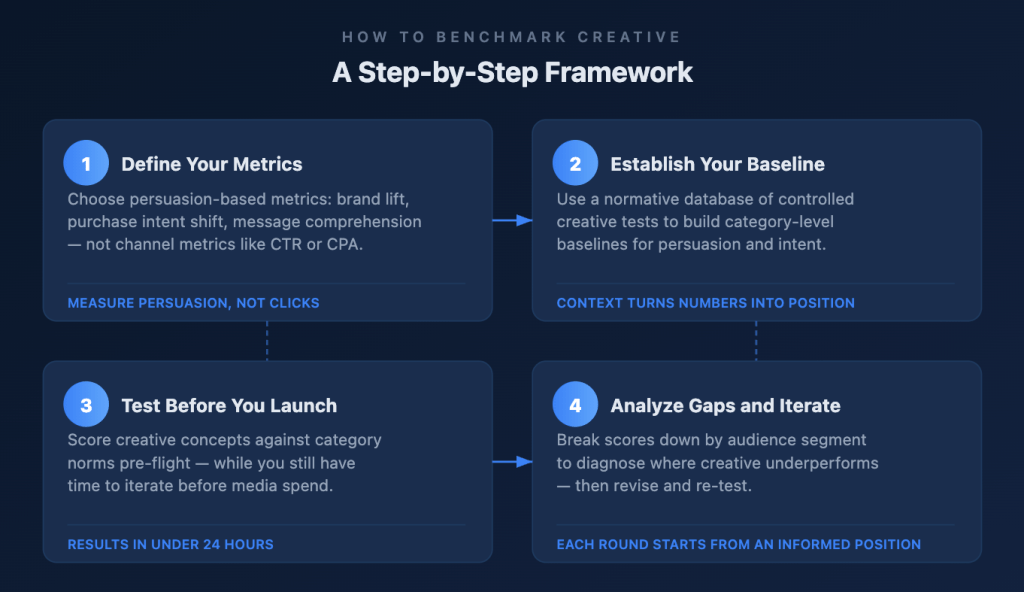
Step 1: Define what you are measuring
If you are comparing click-through rates against industry averages, you are doing performance benchmarking. That is a legitimate exercise, but it will not tell you whether your creative is persuasive. For creative benchmarking, the metrics are persuasion-based:
- Brand lift: the measured change in awareness, consideration, or favorability caused by exposure to the creative
- Purchase intent shift: the change in stated likelihood to buy
- Message comprehension: whether the intended takeaway registered
These are measured through randomized controlled trials, not ad server logs.
Step 2: Establish your category baseline
The benchmarks worth having are not published on a help center. They come from normative databases built by running large volumes of controlled creative tests across categories and aggregating the results into category-level baselines for persuasion, consideration, and intent.
With a baseline, a lift score becomes a position. A 5.8-point lift on consideration means one thing if the category median is 4 points and another if it is 8. Without the baseline, 5.8 points is a number on a slide.
Step 3: Test your creative against the baseline before launch
The most valuable time to benchmark is before launch, while the creative can still change. Pre-flight scoring means testing concepts against category norms before committing media dollars.
This reverses the traditional model. Instead of launching, measuring after the campaign ends, and hoping to apply the lesson next quarter, pre-flight scoring gives a competitive read while there is time to iterate. A concept in the bottom quartile of its category can be revised or replaced before an impression is served. What used to be a six-to-eight-week research engagement now completes in days.
Step 4: Diagnose gaps and iterate
When creative scores below the benchmark, the question is not whether the ad is bad. It is where it underperforms. A below-benchmark persuasion score can point to a framing problem, an audience mismatch, a format issue, or a positioning gap.
Breaking the benchmark down by audience segment usually produces the most actionable read. An ad can score at the 60th percentile overall and the 30th among the highest-value segment. That is a targeting and messaging problem benchmarking makes visible and in-market data would never surface.
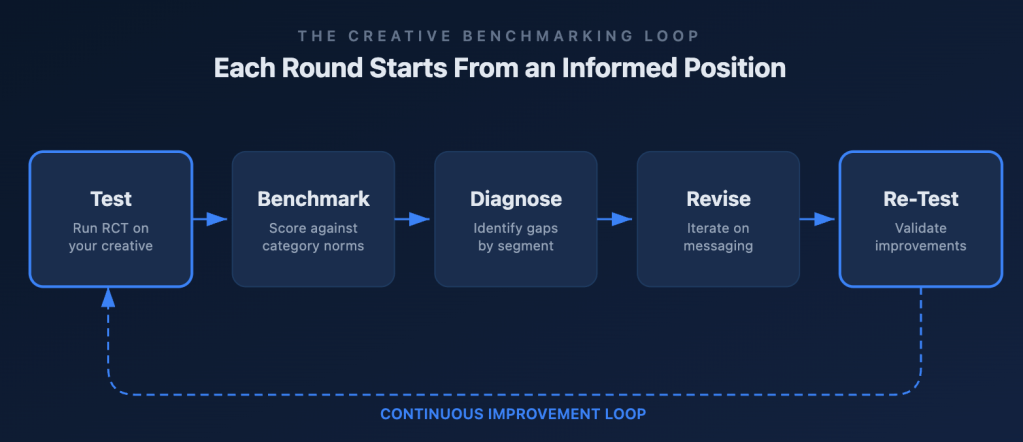
The loop is: test, benchmark, diagnose, revise, re-test. Teams that build it into creative development produce stronger work over time because each round starts from an informed position.
What a Real Benchmark Looks Like
19 corporate reputation ads, ranked twice
In 2026 we tested 19 corporate social responsibility and reputation ads from 16 major brands, each in its own randomized controlled trial against a placebo, with 915 to 1,542 respondents per ad. Every ad was then ranked twice: once on brand recall and once on persuasion, a composite of favorability, consideration, trust, recommendation intent, and reputational resilience.
The two rankings barely overlapped. Toyota had the highest brand recall in the study, with 94% of viewers able to name the brand, and ranked 14th of 19 on persuasion. Amazon recalled at 91%, fifth-highest, and finished last, the only ad to move the composite backward. Subaru and Shell sat in the bottom half on recall and finished first and second on persuasion.
That is what a benchmark does that a single test cannot. Any one of those brands, testing its own ad alone, would have received a lift score and a recall score and no way to know that the two were pointing in opposite directions relative to the field. The full findings are in Brand Recall vs. Ad Persuasion: What 19 CSR Ads Reveal.
Why Pre-Launch Benchmarking Changes the Decision
From post-mortem to pre-flight
The traditional creative measurement model is a post-mortem: launch, wait for the campaign to end, run a brand lift study, and learn three months later that the creative underperformed. By then the budget is spent and the team is on the next brief.
Pre-launch benchmarking puts competitive context at the point where it has the most leverage, before media investment. It has three compounding effects:
- Reduces waste by keeping underperforming creative from reaching market
- Gives creative teams a measurable standard to aim for
- Replaces subjective debate about creative with evidence
How ViewShift Index makes this possible
ViewShift Index is built on a normative database of pre-launch creative tests across categories and audiences. When you test creative through ViewShift, the persuasion score comes with its position in the category: where it ranks, what the top performers look like, and where the gaps are.
This is the benchmarking infrastructure that used to be available only to the largest advertisers working with legacy research firms. It is now available to any team, with results delivered in days rather than weeks. Learn more about ViewShift Index.
Frequently Asked Questions About Creative Benchmarking
Frequently asked
What is competitive benchmarking in marketing?
Measuring your brand's performance against competitors or category norms. For creative specifically, it means measuring how well your ads shift consideration and purchase intent relative to other creative in your category, using controlled experiments rather than platform metrics.
How do I find industry benchmarks for digital marketing?
Platform-reported averages such as Google Ads CTR benchmarks and Meta engagement rates are widely available but measure only channel efficiency. Creative effectiveness benchmarks need a normative database of controlled creative tests across your category, which specialized research platforms provide and ad platforms do not.
What is the difference between performance benchmarking and creative benchmarking?
Performance benchmarking compares operational metrics like CTR, CPA, and ROAS against category averages. Creative benchmarking measures persuasion: how much your creative shifts consideration, intent, and awareness relative to competitors. A campaign can be operationally efficient and creatively ineffective at the same time.
How do you benchmark creative?
Four steps. Define persuasion-based metrics: brand lift, purchase intent shift, message comprehension. Establish a category baseline from a normative database of controlled tests. Test your creative against that baseline before launch. Diagnose gaps by audience segment and iterate.
When is the best time to benchmark creative?
Before committing media budget. Testing after a campaign ends tells you what happened without time to change anything. Pre-flight scoring compares concepts against category norms while they can still be revised or replaced.
How much does competitive creative benchmarking cost?
Legacy research firms charged $50,000 or more for a single benchmarking study on a six-to-eight-week timeline. Modern pre-launch platforms deliver the same comparison at a fraction of that cost, with results in days.
Key Takeaways
- Performance benchmarks measure channel efficiency. Creative benchmarks measure persuasion. They are different numbers about different things.
- A lift score without a category baseline is a number on a slide. With one, it is a position.
- The highest-leverage moment to benchmark is before launch, while the creative can still change.
- In the 2026 CSR benchmark, the ads with the highest recall were not the ads that persuaded. Only a field of comparable tests could show that.
- Break the benchmark down by segment. An ad can be above average overall and below average with the audience that matters most.
See where your creative stands in its category before a dollar goes to media. Request a ViewShift Index demo →